

Why Does Comprehensive Editing Cost So Much More Than Copy Editing?
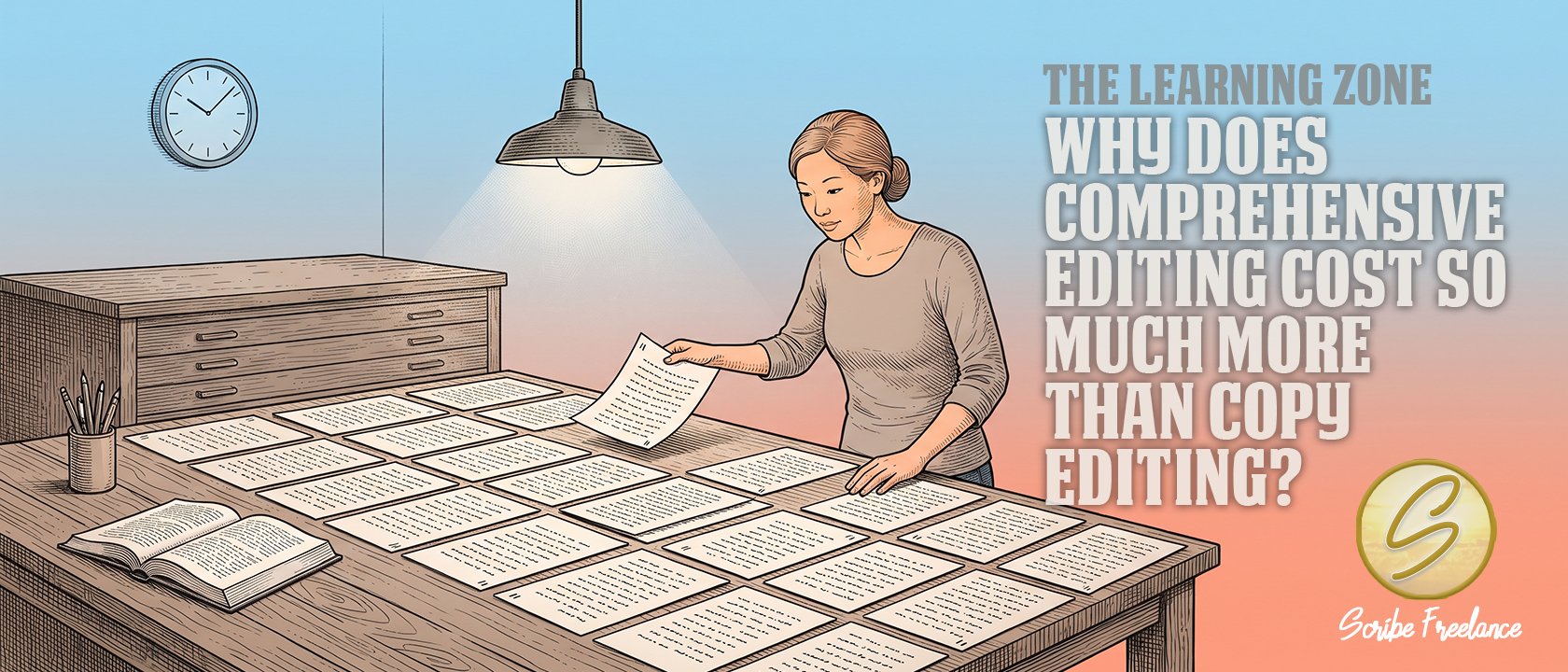
A copyedit works one page at a time. Comprehensive editing has to see the whole manuscript at once, and that’s where the hours go.
On a rate card, the cost gap between comprehensive editing and copy editing looks like a markup: two prices per 250 words for the same manuscript. What the higher number actually pays for is time.
A comprehensive pass moves through every page more slowly because it checks things a copyedit never touches — how the material is organized, and whether the content itself holds up.
My name is Daniel J. Middleton, and I’ve been on the formatting and editing side of book publishing for over two decades now — enough of them to stop being surprised by where things go sideways.
This piece breaks down what that extra cost buys, using a real manuscript that was scoped as a copyedit and turned out to need a great deal more.
Why Does the Price Gap Between Copy Editing and Comprehensive Editing Look So Arbitrary?
My current rates put copy editing at $7.75 per 250 words and comprehensive editing at $11.00. That’s $3.25 more per unit, or roughly 42 percent. On a 60,000-word manuscript, it’s the difference between $1,860 and $2,640 — $780 more for what looks, from the outside, like the same job done more carefully.
Rates change, so treat those figures as today’s numbers rather than permanent ones. The gap itself is the point.
A rate card can only show you what one unit costs. It can’t show you how long a unit takes to edit, and that’s where the two tiers actually split apart.
If you’re still sorting out what each tier is allowed to touch in the first place, where copy editing ends and comprehensive editing begins draws that line directly.
What Is the Extra Cost of Comprehensive Editing Actually Paying For?
The short version is hours. The longer version is where those hours go.
More questions on every page. A copyedit reads each page for grammar, style, consistency, and word usage. A comprehensive pass asks all of that, then asks whether each passage belongs where it sits and whether it does the job it’s there to do. More questions per page means more time per page.
Rework, not just correction. Copy editing corrects what’s already written. Comprehensive editing sometimes has to rebuild a passage or a whole section so it reads clearly and carries its weight — slower work than fixing a sentence in place.
Holding the whole manuscript in view. Structural problems rarely show up on a single page. They show up when a section repeats ground covered three chapters earlier, or when an argument doesn’t connect to the one before it. Catching that means reading across the manuscript, not just down it — time that simply doesn’t exist in a copyedit.
None of that is a premium stacked on top of the same work. It’s a different kind of work, and it takes longer to do.
What Happened When a Manuscript Scoped for Copy Editing Needed Comprehensive Editing?
Years ago, a graduate student came to me convinced his manuscript only needed copy editing. His sentences weren’t really the issue.
Once I got into the material, it was clear it lacked the research depth its subject actually required. Whole sections needed to be reworked, and facts had to be checked and updated so they met the standard the work was being held to.
A copyedit could have polished every sentence in those sections and left the gaps under them exactly where they were.
What the manuscript needed was different work: reading for what was missing, verifying what was there, and rebuilding sections until they could stand on their own. That’s a different job from the one he thought he was hiring for.
I don’t have figures from that project worth quoting here. It’s old enough that any dollar amount would mislead more than it helps. But it shows the price gap working the way it’s meant to: the manuscript needed hours a copyedit never budgets for.
A copy-editing rate prices cleanup on material that’s already complete. A comprehensive-editing rate prices the work of getting it there first.
Price can move the other way, too. On a separate project, a quote I’d built at the copy-editing rate came in lower once the finished manuscript turned out to need only a light proofread. In either direction, the rate follows what the pages actually need, not what anyone assumed going in.
How Can You Tell Whether Your Manuscript Needs the Comprehensive Editing Price?
Before you decide the higher rate is overkill, read your own manuscript for the kinds of problems a copyedit won’t reach:
Sections you already know are thin. If you’ve been hoping a particular chapter will get by, it probably needs more than cleaner sentences.
Facts you haven’t rechecked. Figures, dates, sources, or claims written down once and never verified since.
Pieces that don’t quite connect. A chapter that feels like it belongs somewhere else, or a point that gets made twice without adding anything new.
If none of that applies and your notes are mostly about wording and consistency, copy editing is the right tier, and the cheaper one. If some of it does apply, the extra $3.25 per unit isn’t a markup. It’s the part of the job that actually addresses those problems.
If you want to see what either tier comes to at your manuscript’s real word count, my current service rates lay both out side by side.